India! Land of contrast and opportunity.
If you haven't fallen in love with India yet,
let us help you get to know this incredible country.
If you haven't fallen in love with India yet,
let us help you get to know this incredible country.
Background:
The Indus Valley civilization is one of the oldest in the world and dates back at least 5,000 years. Aryan tribes
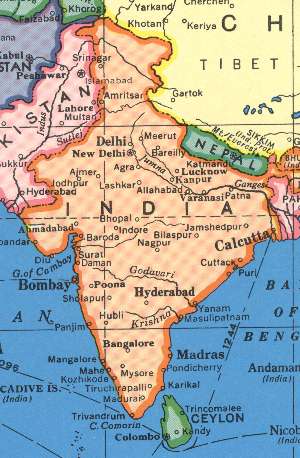 from the northwest invaded about 1500 B.C. Their merger with the earlier inhabitants created the classical Indian culture. Arabs started coming around the 8th century and Turkish in the 12th. This was followed by European traders from the later 15th century. Britain essentially had political control of India by the 19th century. Nonviolent resistance to British colonialism under Mohandas GANDHI and Jawaharlal NEHRU led to independence in 1947.
 General Info:
The subcontinent was divided into the secular state of India and the smaller Muslim state of Pakistan. In 1971 a third war between the two
 countries resulted in East Pakistan becoming the separate nation of Bangladesh. Major concerns in India include the ongoing dispute with Pakistan over Kashmir, massive overpopulation, environmental degradation, extensive poverty, and ethnic and religious strife. Yet India has impressive gains in economic investment and output.
Area:
total: 3,287,590 sq km
land: 2,973,190 sq km
water: 314,400 sq km
land: 2,973,190 sq km
water: 314,400 sq km
slightly more than one-third the size of the USClimate:
varies from tropical monsoon in south to temperate in northPopulation:
1,065,070,607 (July 2004 est.)
Age Structure:
0-14 years: 31.7% (male 173,869,856; female 164,003,915)
15-64 years: 63.5% (male 349,785,804; female 326,289,402)
65 years and over: 4.8% (male 25,885,725; female 25,235,905) (2004 est.)
15-64 years: 63.5% (male 349,785,804; female 326,289,402)
65 years and over: 4.8% (male 25,885,725; female 25,235,905) (2004 est.)
Median Age: 24.4
Religious affiliation:
Hindu 81.3%, Muslim 12%, Christian 2.3%, Sikh 1.9%, other groups including Buddhist, Jain, Parsi 2.5% (2000)
Languages:
Hindi is the national language and primary tongue of 30% of the people. English has "associate status" but is the main language for national, political, and commercial communicatio. There are 14 other official languages: Bengali, Telugu, Marathi, Tamil, Urdu, Gujarati, Malayalam, Kannada, Oriya, Punjabi, Assamese, Kashmiri, Sindhi, and Sanskrit. Hindustani is a popular variant of Hindi/Urdu spoken widely throughout northern India but is not an official language.
Economy:
India's economy encompasses traditional village farming, modern agriculture, handicrafts, a wide range of modern industries, and a multitude of support services. Government controls have been reduced on foreign trade and investment, and privatization of domestic output has proceeded slowly. The economy has posted an excellent average growth rate of 6% since 1990, reducing poverty by about 10 percentage points. India is capitalizing on its large numbers of well-educated people skilled in the English language to become a major exporter of software services and software workers. Despite strong growth, the World Bank and others worry about the continuing public-sector budget deficit, running at approximately 60% of GDP.Major Industries:
textiles, chemicals, food processing, steel, transportation equipment, cement, mining, petroleum, machinery, software.Exports:
Agriculture: rice, wheat, oilseed, cotton, jute, tea, sugarcane, potatoes; cattle, water buffalo, sheep, goats, poultry; fish.
textile goods, gems and jewelry, engineering goods, chemicals, leather manufactures...Natural Resources:
About $57.24 billion f.o.b. - 04 est.
Export Partners: US 20.6%, China 6.4%, UK 5.3%, Hong Kong 4.8%, Germany 4.4% (2003)
coal (fourth-largest reserves in the world), iron ore, manganese, mica, bauxite, titanium ore, chromite, natural gas, diamonds, petroleum, limestone, arable land.Natural Hazzards:
droughts; flash floods, as well as widespread and destructive flooding from monsoonal rains; severe thunderstorms; earthquakes.Environmental Issues:
deforestation; soil erosion; overgrazing; desertification; air pollution from industrial effluents and vehicle emissions; water pollution from raw sewage and runoff of agricultural pesticides; tap water is not potable throughout the country; huge and growing population is overstraining natural resources.
Telephones:
Main lines in use: 48.917 million (2003)
Mobile cell phones: 26.154 million (03)
Mobile cell phones: 26.154 million (03)
HIV/AIDS:
Approximate number with AIDS: 3.97 million (2001 est.)
Communications:
Primary Source: World Fact BookRadio Staions: AM 153, FM 91, shortwave 68 (1998)
Television Stations 562 ('97 stats)
Internet users: 18.481 million ('03)

No comments:
Post a Comment